
How to Calculate Your Macros for Nutrition Goals?
Learn how to calculate your daily macronutrient needs (protein, fats, and carbohydrates) by determining your calorie target and then distributing calories among macros based on common percentage ranges or grams per kilogram of body weight.
Written by the Nutrition Tutor Academy teaching team from 1 primary source. How we source →
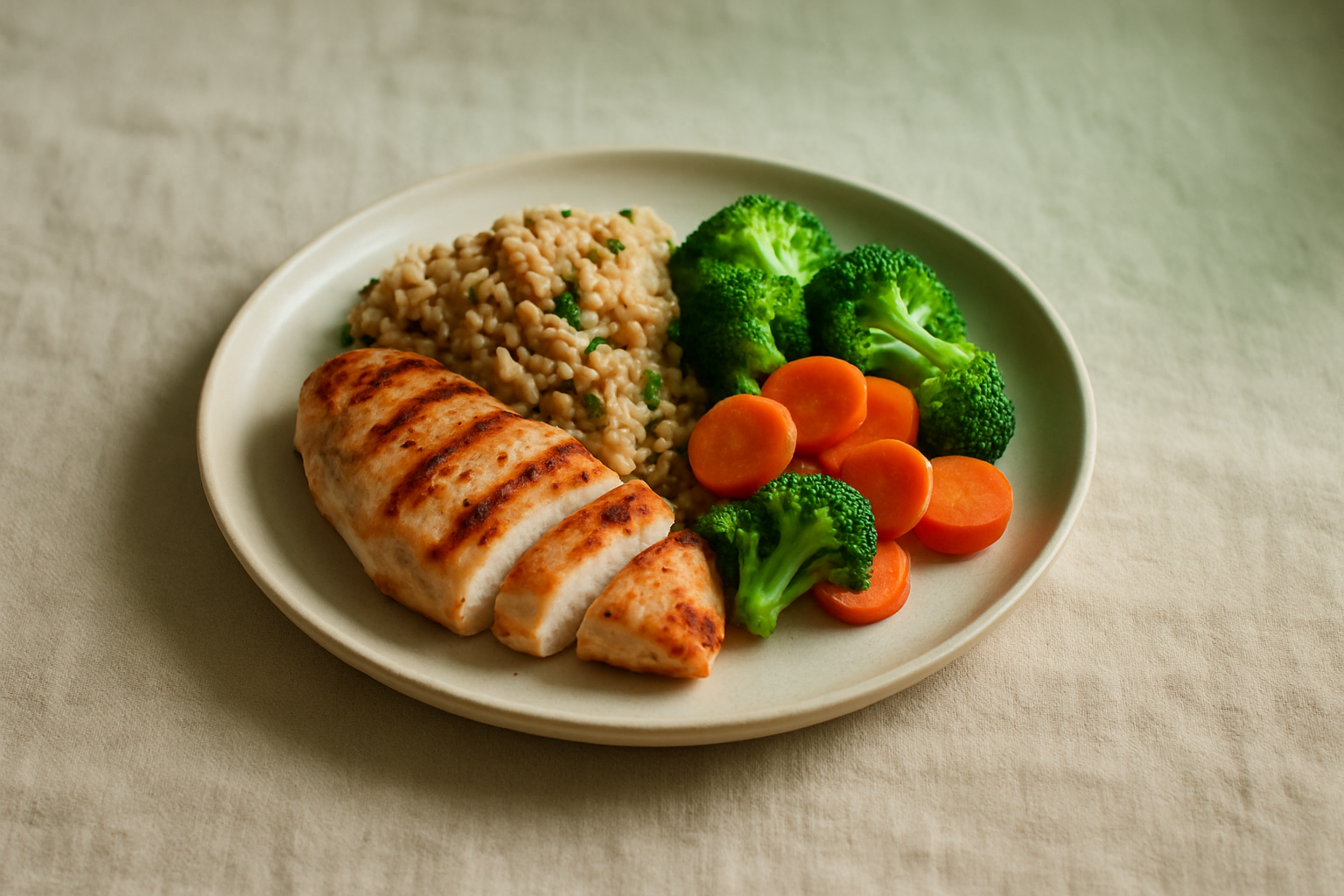
Quick answer: Calculating your macros involves first determining your daily calorie needs, then allocating those calories among protein, carbohydrates, and fats. This allocation can be done using percentage ranges, such as 10-35% of calories from protein, 20-35% from fat, and 45-65% from carbohydrates. For protein, a common recommendation is 0.8 grams per kilogram of body weight, though some suggest higher for specific goals.
Quick facts
- Macros refer to macronutrients: protein, carbohydrates, and fats.
- First step in macro calculation is determining your daily calorie needs.
- Protein provides 4 calories/gram, carbohydrates 4 calories/gram, and fats 9 calories/gram.
- Common protein recommendation: 0.8g per kg body weight, or higher for muscle support.
- Macro targets can be set as percentages of total calories or specific grams.
- Adjusting macro ratios supports various goals like weight loss or muscle gain.
Embarking on a nutrition journey often involves understanding more than just total calories. Macronutrients – protein, carbohydrates, and fats – are the three main components of food that provide energy and are essential for bodily functions. Calculating your macros means determining the specific amounts of each macronutrient you should consume daily to support your individual health and fitness goals.
What are Macronutrients and Why are They Important?
Macronutrients, or 'macros,' are nutrients your body needs in large amounts for energy, growth, and repair. Protein is crucial for building and repairing tissues, forming enzymes and hormones, and maintaining muscle mass. Carbohydrates are the body's primary source of energy. Fats are vital for hormone production, nutrient absorption, and protecting organs.
How Do I Determine My Daily Calorie Needs?
Before you can calculate your macros, you need to establish your daily calorie target. This depends on factors like your age, sex, weight, height, activity level, and goals (e.g., weight loss, maintenance, muscle gain). There are various formulas and online calculators available that estimate your Basal Metabolic Rate (BMR) – the calories burned at rest – and then adjust it based on your activity level to get your Total Daily Energy Expenditure (TDEE). For example, a moderately active individual aiming for weight maintenance might find their TDEE to be around 2,000-2,500 calories. If your goal is weight loss, you would typically aim for a deficit (e.g., 250-500 calories less than your TDEE); for weight gain, a surplus.
What are Recommended Macro Ratios?
Once your daily calorie target is set, you can allocate those calories among protein, carbohydrates, and fats. Common general recommendations for macronutrient distribution (as a percentage of total calories) are:
- Protein: 10-35% of total daily calories. Research suggests that for healthy aging and maintaining muscle mass, individuals might benefit from higher protein intake than the minimum recommendations Source.
- Fats: 20-35% of total daily calories.
- Carbohydrates: 45-65% of total daily calories.
These are starting points and can be adjusted based on personal preference, dietary restrictions, and specific goals. For instance, an athlete might opt for higher carbohydrates, while someone focusing on fat loss might temporarily increase protein.
How Do I Convert Percentages to Grams?
To get the exact number of grams for each macronutrient, you need to know their caloric values:
- Protein: 4 calories per gram
- Carbohydrates: 4 calories per gram
- Fats: 9 calories per gram
Worked Example:
Let's assume your daily calorie target is 2,000 calories and you choose a macro distribution of 30% protein, 30% fat, and 40% carbohydrates.
-
Calculate Protein Calories: 2,000 calories * 0.30 = 600 calories from protein Convert to Grams: 600 calories / 4 calories/gram = 150 grams of protein
-
Calculate Fat Calories: 2,000 calories * 0.30 = 600 calories from fat Convert to Grams: 600 calories / 9 calories/gram = 67 grams of fat (rounded)
-
Calculate Carbohydrate Calories: 2,000 calories * 0.40 = 800 calories from carbohydrates Convert to Grams: 800 calories / 4 calories/gram = 200 grams of carbohydrates
So, for a 2,000-calorie diet with this distribution, your daily macros would be approximately 150g protein, 67g fat, and 200g carbohydrates.
What If I Have Specific Protein Goals?
Instead of a percentage, you might start with a specific protein target. A general guideline for adults is 0.8 grams of protein per kilogram of body weight. However, for those looking to build muscle or maintain muscle during weight loss, recommendations often range from 1.6 to 2.2 grams of protein per kilogram of body weight. For example, a person weighing 70 kg (about 154 lbs) aiming for muscle maintenance might target 70 kg * 1.8 g/kg = 126 grams of protein.
If you start with a specific protein goal in grams, calculate its caloric contribution, subtract it from your total calorie target, and then distribute the remaining calories between fats and carbohydrates using your preferred percentages.
How Do I Track My Macros?
Once you have your calculated macro targets, you can use food tracking apps or journals to monitor your daily intake. Log everything you eat and drink, and the app will typically break down the macronutrient content. This helps you compare your actual intake against your targets and make adjustments to your food choices throughout the day to meet your goals.
Key takeaways
- 01Start by determining your total daily calorie needs based on your body, activity, and goals.
- 02Allocate a percentage of these calories to protein (10-35%), fats (20-35%), and carbohydrates (45-65%).
- 03Convert calorie allocations into grams using: 4 kcal/g for protein/carbs, 9 kcal/g for fats.
- 04Consider higher protein intake (1.6-2.2 g/kg body weight) for muscle building or preservation.
- 05Use tracking apps to monitor your daily macro intake and adjust food choices accordingly.
Frequently asked
What is the difference between calories and macros?+
Calories are units of energy, while macros (macronutrients) are the types of nutrients that provide those calories: protein, carbohydrates, and fats. You need a certain number of calories, and macros define how those calories are composed.
Do I need to track macros if I'm just trying to eat healthy?+
Not necessarily. For general healthy eating, focusing on whole, unprocessed foods and balanced meals may be sufficient. Macro tracking is typically used for more specific goals like muscle gain, significant weight loss, or performance optimization.
Are there different macro ratios for weight loss versus muscle gain?+
Yes, macro ratios can be adjusted. For weight loss, a higher protein intake is often recommended to preserve muscle mass. For muscle gain, both protein and carbohydrates are typically increased to support muscle synthesis and provide energy for workouts.
Is a low-carb or low-fat diet better for macro calculation?+
The 'best' diet varies by individual. When calculating macros, you can adjust the carbohydrate and fat percentages to fit a lower-carb or lower-fat approach, as long as you maintain overall calorie goals and adequate nutrient intake. Consult a nutrition professional for personalized advice.
How often should I recalculate my macros?+
You should recalculate your macros when your body weight changes significantly, your activity level shifts, or your fitness goals evolve. For instance, if you've lost a considerable amount of weight, your calorie needs will decrease.
Can I use an online calculator to find my macros?+
Yes, many reputable online calculators can provide an initial estimate for your daily calorie needs and suggested macro breakdowns. However, these are general guidelines, and personal adjustment based on your body's response is often necessary.
Sources
Every lesson is drafted from primary sources - official announcements, vendor blogs, and reputable industry reporting - then edited by our pipeline.
More on Macros & Energy
See all →Jan 1, 1970
Carb Cycling Explained: A Guide to Strategic Carbohydrate Intake
This lesson explains carb cycling, a dietary strategy that varies carbohydrate intake daily or weekly to support fitness and health goals, differentiating between high-carb and low-carb days.
Jan 1, 1970
How Many Carbs Should I Eat? A Guide to Daily Carbohydrate Intake
Learn how to determine your ideal daily carbohydrate intake based on your energy needs, activity level, and health goals, ranging from general recommendations to specific dietary approaches.
Jan 1, 1970
High-Protein Foods for Weight Loss: Your Essential Guide
Discover how incorporating high-protein foods can support weight loss by enhancing satiety, preserving muscle, and boosting metabolism.
Jan 1, 1970
How Many Grams of Protein Are in an Egg?
This lesson details the typical protein content of an egg, factors influencing it, and how to incorporate eggs into a protein-rich diet.
Free account
Want to go deeper?
Sign up free to unlock the full daily industry feed, save posts and articles to your library, and chat with the coach about anything you read.